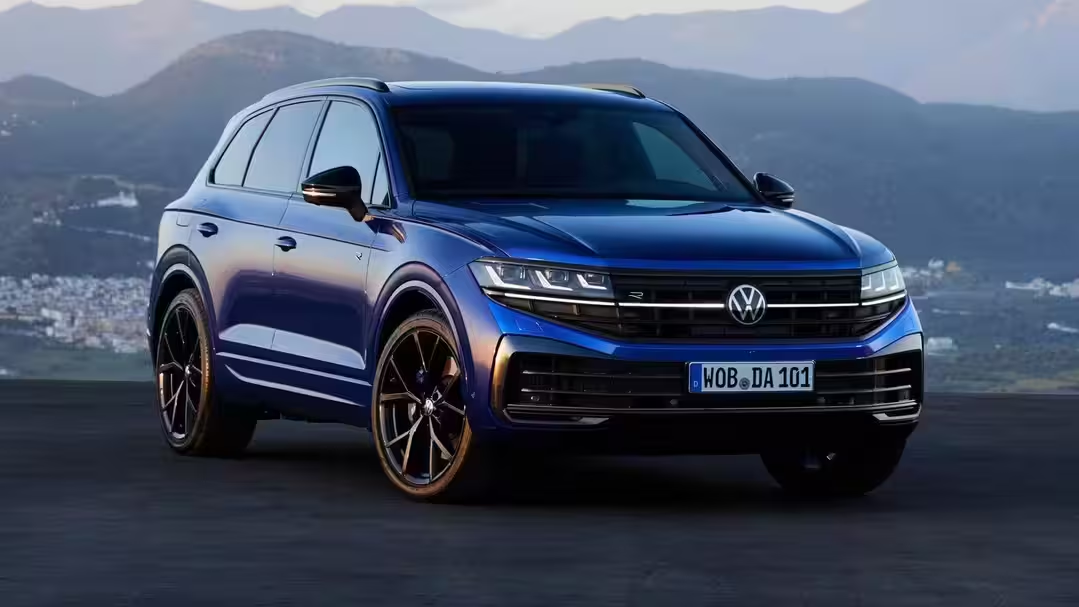
Names like Volkswagen speak to excellence in European design, quality, and innovation. From the venerable Beetle to the always popular Golf GTI, Volkswagen cars have developed a devoted following all around. Particularly among fans for automotive tuning, these vehicles are appreciated for their dependability in engineering, elegant appearance, and performance possibilities.
Regarding vehicle modifications, though, something interesting occurs in Australia. Australians seem less likely than those in other areas, including Europe or North America, to extensively change their Volkswagens. but why is that?
Let’s examine closely the cultural, financial, and legal aspects influencing this distinctive vehicle movement Down Under.
1. The Expensive Australian Modification Costs
The cost involved in changing Volkswagen vehicles in Australia is one of the most major obstacles. Particularly when purchased from outside, genuine Volkswagen parts can be somewhat expensive. Using original components is crucial for performance and lifetime for many enthusiasts, but given shipping, taxes, and currency conversion, these parts are not inexpensive.
Furthermore, Australian worker expenses are somewhat high, especially for specialised automotive services. Because of the complicated engineering and need for accuracy of the brand, mechanics specialising in European cars—especially Volkswagens—often charge premium rates. Availability can be limited even with aftermarket parts, which would raise import costs and wait periods.
These expenses might rapidly overwhelm the average automobile enthusiast trying to keep within budget. Many Aussies may so decide to leave their Volkswagen vehicles in stock condition, utilising them more for daily commuting than as platforms for performance improvements or cosmetic changes.
2. Reliability and Practicality Over Flash
Particularly models like the Golf, Passat, and Tiguan, Volkswagen cars are renowned for their mix between comfort and performance. Given the large distances sometimes travelled between cities or rural areas, Australians frequently value vehicle dependability and utility highly.
Changing a car—for cosmetic or performance enhancement—can occasionally jeopardise dependability. When done incorrectly or with unsuitable parts, problems include engine misfires, ECU faults, or perhaps legal problems could follow.
In a nation where your car can have to go hundreds of km on one trip, dependability counts. Drivers last want is a breakdown in the middle of nowhere brought on by a faulty modification.
Many Australians so approach their Volkswagens with a “don’t fix what isn’t broken” attitude, giving long-term dependability first priority over transient pleasures.
3. A Less Active, Smaller Enthusiast Community
Although Australia boasts a devoted Volkswagen community, it is far smaller and less active than those in Germany, the United States, or even the UK. VW tuning culture is firmly ingrained in these areas, with many clubs, events honouring altered Volkswagens.
In Australia, though, the scene for enthusiasts is more disjointed. There are few events notably outside of big cities like Sydney or Melbourne that appeal primarily to Volkswagen modifications. Though they exist, online forums and social media groups lack the volume and activity required to support consistent interaction, learning, and inspiration.
This lowered visibility can make changing Volkswagens in Australia seem more solitary. Newcomers to the scene may be less driven to engage in modification projects without a robust network to distribute experiences, recommendations, or troubleshooting guidance.
4. Dominance of Other Modifiable Brands
Regarding car tuning in Australia, Japanese brands rule absolutely. Particularly in the JDM (Japanese Domestic Market) segment, Toyota, Nissan, Honda, and Subaru predominate among the local modification scene cars.
Not only are secondhand vehicles like the Subaru WRX, Toyota Supra, and Nissan Silvia less expensive, but they also come with a wide choice of reasonably priced aftermarket parts easily found in the area.
This dominance is cultural rather than only about availability. Years of impact from Japanese motorsport, drifting, and rallying have helped to define Australia’s automotive scene. Young automobile aficionados so are more inclined to flock towards Japanese cars that provide modding potential, street cred, and community support.
Comparatively, Volkswagens are sometimes considered as more sophisticated, less hostile, and more expensive to change. This impression drives many Aussies towards more grassroots appealing businesses.
5.Tight Laws on Vehicle Modification
Strict car modification rules in Australia are another important influence at work. Although each state has different requirements, generally they demand any change—from a suspension drop to a turbo upgrade to even a wheel size change—to be totally compliant with ADR (Australian Design Rules) and typically call for engineering certification.
Without tripping compliance alarms or check engine lights, Volkswagens—with their complex onboard technology and precision German engineering—can be especially difficult to change. Ignoring the legal requirements could lead to heavy fines, insurance voiding, or perhaps a car judged unroadworthy.
These rules discourage hobbyist modders even if they are meant to be based on environmental preservation and safety. Unlike in the US, where changes are generally more liberally controlled, Australia’s red tape creates still another obstacle for possible VW tuners to clear.
6. An Original Automotive Culture
A region’s way of life, topography, and history all are profoundly related to car culture. In Europe, where cities are small and road trips are shorter, the focus is often on urban performance and style—making Volkswagens like the Golf GTi, Polo, and Scirocco natural favourites for modification natural favourites for modification.
Australia’s driving culture, on the other hand, tends towards tough capabilities and adventure-ready construction. Particularly in rural and coastal areas where 4WDing and overlanding major weekend activities, off-road cars as the Toyota LandCruiser, Ford Ranger, and Nissan Patrol are rather more common in Australia’s car scene.
Building a raised 4×4 or a turbocharged JDM drift vehicle is generally considered as more sensible—or just more exciting—than fine-tuning a European hatchback for the typical Australian auto enthusiast. The kinds of automobiles that get modified and their frequency depend much on this cultural difference.
The Case for Modifying Volkswagens in Australia
Notwithstanding these difficulties, a devoted and expanding group of Australians take great satisfaction in altering Volkswagens. The possibilities are quite clear whether you are outfitting a Transporter van for van-life adventures or tweaking a Golf R for track use.
Although the terrain may be more difficult, a modified Volkswagen can be the ideal way for aficionados who value uniqueness, polished performance, and modest design to convey both enthusiasm and personality.
With more internet resources, more access to worldwide parts suppliers, and the slow but steady expansion of the local VW community, customised Volkswagens in Australia might have a more prominent future.
Conclusion
Why then do Australians change Volkswagens less than others worldwide?
It boils down to a mix of tight rules, economic challenges, cultural preferences, and little community support. For individuals who are driven by performance and design, Volkswagens still appeals even if these elements may deter broad changes.
If you are an Australian considering changing your VW, know that although the road may be less taken, it is absolutely worthwhile. Creating a unique Volkswagen in Australia is more than doable with the correct knowledge, network, and resources.