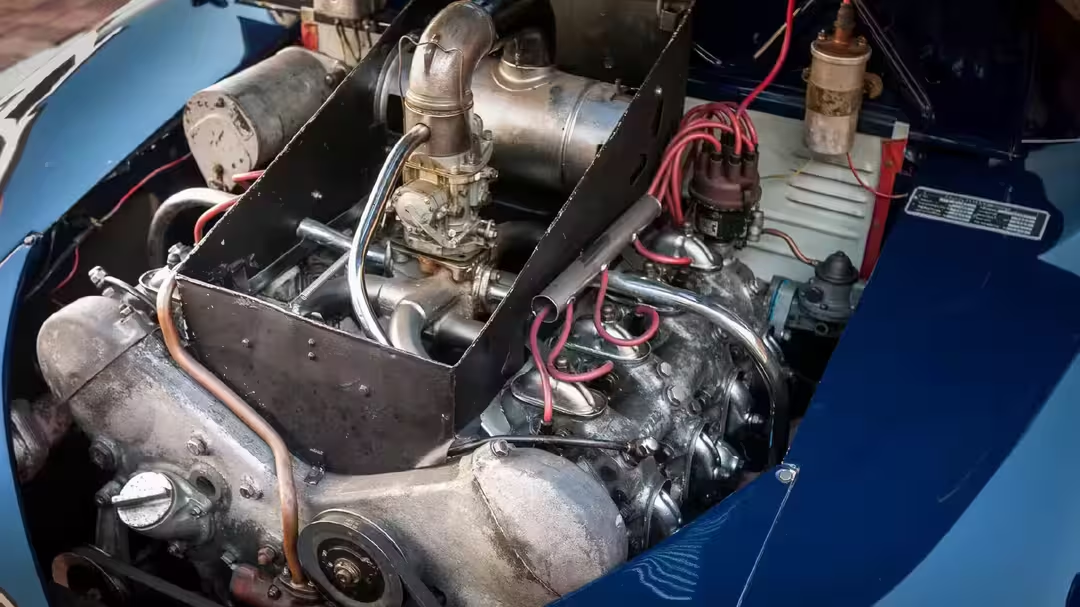
Motorsport history has always valued European automotive engineering highly. From the roaring Formula 1 circuits to the exhausting Le Mans endurance, European engines have always pushed the envelope of performance and creativity. Among all the legends, nevertheless, one engine performs better than the others: the Ferrari Colombo V12. This remarkable engine marked a time rather than merely running vehicles. Remarkably successful European engine in motorsports worldwide, the Colombo V12 boasts an outstanding record and innovative architecture.
The Ferrari Colombo V12: A Sportive Icon Legacy and History
History and Legacy
The Ferrari Colombo V12 began life in 1947 when Enzo Ferrari, the company’s creator, hired eminent engineer Gioachino Colombo to create an engine for his first production vehicle. What surfaced was the beating core of a legacy, not only an engine. The first Ferrari to carry the recognizable Prancing Horse badge was the 125 S, which debuted this ground-breaking powertrain.
The Colombo V12 would eventually run a succession of racing greats including the 250 GTO, 275 GTB, and 330 P4, each of which was essential in determining Ferrari’s supremacy on the track. The engine changed with technical developments but had the same engineering philosophy stressing performance, balance, and racing DNA through the 1950s, 60s, and beyond.
Its continuous performance in Formula 1 and endurance racing emphasized Ferrari’s confidence in its own capacity. Not another European engine has enjoyed such a legendary presence throughout several decades of motorsport.
Performance That Revised Racing
Raw performance-wise, the Colombo V12 belonged in a class all by itself. Originally shown with a mere 1.5 liters displacement, it was remarkably small yet for its time powerful. Engineers increased their capacity over years to 4.9 liters, producing more horsepower and torque without sacrificing dependability or drivability.
The engine’s unique features included:
High-revving nature: Drivers delighted in pushing it to the redline.
Under pressure, linear power delivery becomes predictable and responsive.
Simplifying weight distribution and handling in lightweight design.
Its flexibility made it ideal for several racing uses, on the fast straights of Le Mans or the tight circuits of F1. Driven by the Colombo V12, the Ferrari 250 GTO is still regarded as one of the best race cars ever constructed; its engine was crucial in this respect.
A Proven Winner: Success in Motorsport
Consistent success is the highest standard in motorsports; the Colombo V12 met it in spades. Over its lifetime, it grew to represent Ferrari’s supremacy on many racing circuits.
Formula 1: The Colombo V12 drove Ferrari’s early 1950s successes, therefore enabling the brand to build its racing heritage.
Le Mans 24 Hours: Ferrari’s several victories at Le Mans in the 1950s and 60s came from cars running models of this engine.
Mille Miglia & Targa Florio: Street races and endurance where the dependability of the Colombo V12 proved priceless.
Performance, dependability, and adaptability combined to make the engine a favorite among racing teams and drivers. Trust in machinery may make all the difference in high-stakes motorsports between success and failure; the Colombo V12 seldom let anyone fail.
Engineering excellence: Designed to lead rather than follow
The Colombo V12 succeeded because it was superbly engineered, not alone because it was quick. The concept of Colombo stressed creative design decisions that stretched the boundaries for what was technically feasible at the time.
Among its unique technical aspects were:
Precision valve timing and improved breathing made possible by overhead camshafts
Improved efficiency and power production come from hemispherical combustion chambers.
Helped to keep structural integrity while lowering weight by alloy construction.
This painstaking attention to detail meant the Colombo engine was mechanically beautiful rather than only powerful. Thanks in part to its adaptability and forward-looking design, the Colombo V12 remained relevant even as more modern engine technologies developed.
Its evolution provided a model for next Ferrari engines, therefore impacting the construction of performance automobiles for the next decades.
Why the Ferrari Colombo V12 Stands Out in Versatility Across Disciplines?
The Ferrari Colombo V12’s great adaptability is among its most striking features. Unlike many high-performance engines designed for one kind of racing, this powerplant excelled in several fields. From sprint competitions to long-distance endurance contests, the engine’s flexibility distinguishes it from competitors.
Its involvement in both prototype and production race vehicles proved how well-rounded the platform actually was. The engine ran with assurance whether it was ripping through the Nürburgring or ruling at Daytona.
Long lifespan and evolution
Although most racing engines have a limited lifetime, the Colombo V12 stayed competitive for more than thirty years. In motorsports, where technology sometimes becomes outdated in just a few seasons, such kind of longevity is practically unheard of.
Ferrari maintained the Colombo engine competitive without sacrificing its basic qualities by means of meticulous modifications and improvements. The fact that contemporary Ferrari V12s still feel its DNA tells eloquently about its ageless architecture.
Cultural and Emotional Effect
The Colombo V12 distinguishes itself perhaps more than any technical statistic by its emotional connection. Both drivers and fans will burn the sound of a Ferrari V12 screaming down a straightaway into their mind. It is musical, more than mechanical.
Like the 250 GTO and the 275 GTB, some of the most visually appealing and successful vehicles ever produced guaranteed that their legacy transcended racetracks and into popular culture. Historians, aficionados, and collectors all agree: this engine represents Ferrari’s golden age.
Ferrari Colombo V12 versus Other European Engines
Although Europe has developed some legendary engines, from the Mercedes-Benz M196 to the Cosworth DFV, none have equaled the Colombo V12 in terms of sheer adaptability, lifetime, and cultural impact.
Dominated F1 but limited flexibility outside of open-wheel racing Cosworth DFV.
Flat-sixes in Porsche: technically excellent but relatively limited in use.
Famous in touring cars, BMW inline-sixes never attained the worldwide reputation of Colombo.
When weighed against these important criteria—performance, success, and emotional appeal—the Ferrari engine shines alone.
Conclusion:
The Ferrari Colombo V12 represents European motorport excellence rather than only an engine. From its modest origins in the 1940s to its ongoing influence on modern racing engines and car collections, it is still the most successful European engine in motorsports worldwide.
Its narrative is one of invention, triumph, and cultural influence all derived from driven engineering. The Colombo V12 drove a legacy that will never be forgotten, not only drove vehicles to the finish line.